


-
PAPER
Effect of Solvents in Electrospray of Ni‐Rich Layered Materials for High‐Performance Cathodes in Lithium‐Ion Batteries

 관리자2025-12-05 조회 188 댓글 0
이메일주소 site@site.co.kr Author JinUk Yoo, Dong Chul Kang, Hyun Chul Kang, Songhun Yoon, Sung Gyu Pyo Journal International Journal of Energy Research Year of Pub. 2025 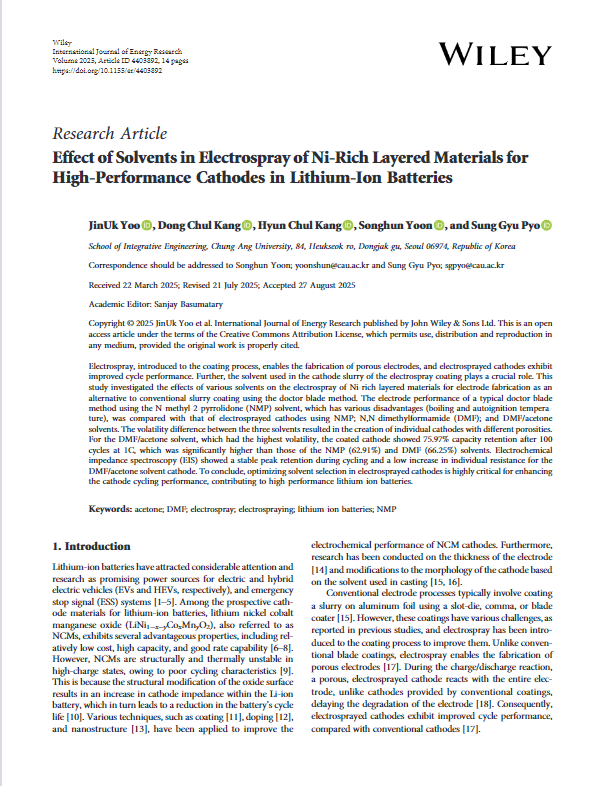
Electrospray, introduced to the coating process, enables the fabrication of porous electrodes, and electrosprayed cathodes exhibit improved cycle performance. Further, the solvent used in the cathode slurry of the electrospray coating plays a crucial role. This study investigated the effects of various solvents on the electrospray of Ni-rich layered materials for electrode fabrication as an alternative to conventional slurry coating using the doctor-blade method. The electrode performance of a typical doctor blade method using the N-methyl-2-pyrrolidone (NMP) solvent, which has various disadvantages (boiling and autoignition temperature), was compared with that of electrosprayed cathodes using NMP; N,N-dimethylformamide (DMF); and DMF/acetone solvents. The volatility difference between the three solvents resulted in the creation of individual cathodes with different porosities. For the DMF/acetone solvent, which had the highest volatility, the coated cathode showed 75.97% capacity retention after 100 cycles at 1C, which was significantly higher than those of the NMP (62.91%) and DMF (66.25%) solvents. Electrochemical impedance spectroscopy (EIS) showed a stable peak retention during cycling and a low increase in individual resistance for the DMF/acetone solvent cathode. To conclude, optimizing solvent selection in electrosprayed cathodes is highly critical for enhancing the cathode cycling performance, contributing to high-performance lithium-ion batteries.
첨부파일 스크린샷_2025-12-05_135643.png (178.15KB) [0] 2025-12-05 13:56:50 다음글 
Tailoring the Bulk Structure and Surface Chemistry of Ni-Rich NCM811 Cathodes via Polyanion Incorporation for Enhanced Electrochemical Performance up to 4.5 V


221 HEUK SEOK-DONG, DONGJAK-GU, SEOUL, KOREA TEL: +82-2-820-5769 FAX: +82-2-814-2651 COPYRIGHT©2013 BY NEL. All Rights Reserved.