


-
PAPER
Tailoring the Bulk Structure and Surface Chemistry of Ni-Rich NCM811 Cathodes via Polyanion Incorporation for Enhanced Electrochemical Performance up to 4.5 V

 관리자2025-12-05 조회 221 댓글 0
Author Youngmin Chi, Jeseon Lee, Hyunchul Kang, Jiung Cho, Eunho Lim, and Songhun Yoon Journal International Journal of Energy Research Year of Pub. 2025 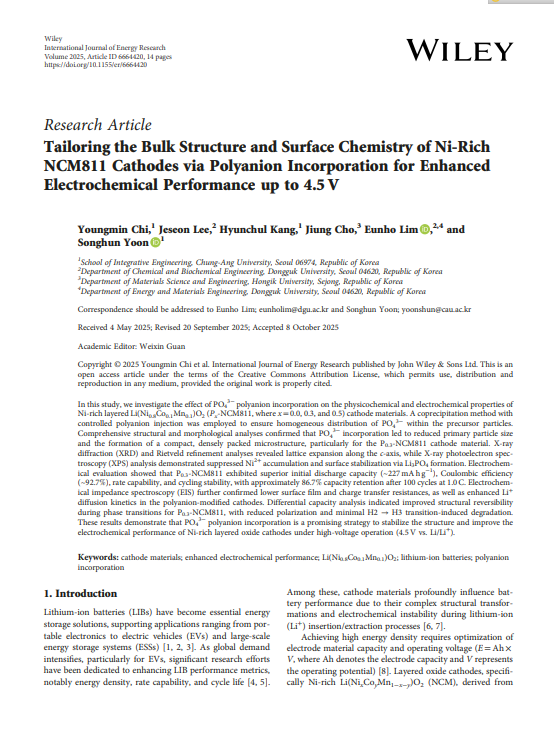
In this study, we investigate the effect of PO43− polyanion incorporation on the physicochemical and electrochemical properties of Ni-rich layered Li(Ni0.8Co0.1Mn0.1)O2 (Px-NCM811, where x = 0.0, 0.3, and 0.5) cathode materials. A coprecipitation method with controlled polyanion injection was employed to ensure homogeneous distribution of PO43− within the precursor particles. Comprehensive structural and morphological analyses confirmed that PO43− incorporation led to reduced primary particle size and the formation of a compact, densely packed microstructure, particularly for the P0.3-NCM811 cathode material. X-ray diffraction (XRD) and Rietveld refinement analyses revealed lattice expansion along the c-axis, while X-ray photoelectron spectroscopy (XPS) analysis demonstrated suppressed Ni2+ accumulation and surface stabilization via Li3PO4 formation. Electrochemical evaluation showed that P0.3-NCM811 exhibited superior initial discharge capacity (~227 mA h g−1), Coulombic efficiency (~92.7%), rate capability, and cycling stability, with approximately 86.7% capacity retention after 100 cycles at 1.0 C. Electrochemical impedance spectroscopy (EIS) further confirmed lower surface film and charge transfer resistances, as well as enhanced Li+ diffusion kinetics in the polyanion-modified cathodes. Differential capacity analysis indicated improved structural reversibility during phase transitions for P0.3-NCM811, with reduced polarization and minimal H2 → H3 transition-induced degradation. These results demonstrate that PO43− polyanion incorporation is a promising strategy to stabilize the structure and improve the electrochemical performance of Ni-rich layered oxide cathodes under high-voltage operation (4.5 V vs. Li/Li+).첨부파일 스크린샷_2025-12-05_135351.png (186.57KB) [0] 2025-12-05 13:55:46


221 HEUK SEOK-DONG, DONGJAK-GU, SEOUL, KOREA TEL: +82-2-820-5769 FAX: +82-2-814-2651 COPYRIGHT©2013 BY NEL. All Rights Reserved.