


-
PAPER
Particle structure optimization of LiNi0.8Mn0.1Co0.1O2 cathodes for enhanced high-voltage operation up to 4.5 V

 관리자2025-12-01 조회 292 댓글 0
Author Sangwon Nam, Junyeob Lim, Dong Chul Kang, Jaegyun Heo, Yeon-su Kim, Dae-ha Shin, Jiung Cho, Songhun Yoon Journal Chemical Engineering Journal Year of Pub. 2025 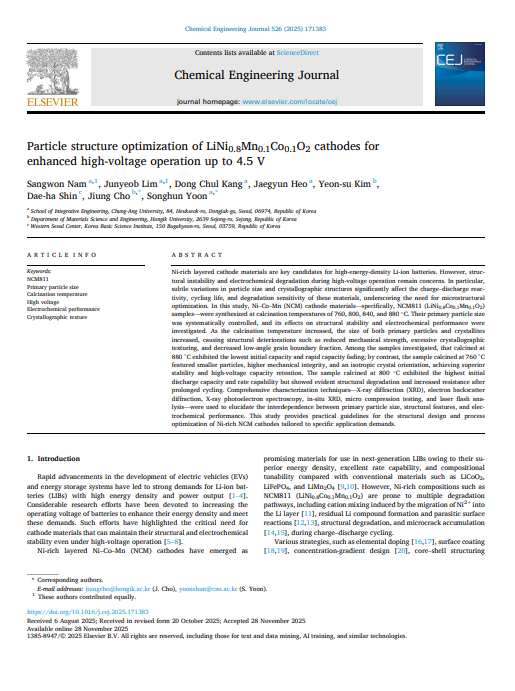
Ni-rich layered cathode materials are key candidates for high-energy-density Li-ion batteries. However, structural instability and electrochemical degradation during high-voltage operation remain concerns. In particular, subtle variations in particle size and crystallographic structures significantly affect the charge–discharge reactivity, cycling life, and degradation sensitivity of these materials, underscoring the need for microstructural optimization. In this study, Ni–Co–Mn (NCM) cathode materials––specifically, NCM811 (LiNi0.8Co0.1Mn0.1O2) samples––were synthesized at calcination temperatures of 760, 800, 840, and 880 °C. Their primary particle size was systematically controlled, and its effects on structural stability and electrochemical performance were investigated. As the calcination temperature increased, the size of both primary particles and crystallites increased, causing structural deteriorations such as reduced mechanical strength, excessive crystallographic texturing, and decreased low-angle grain boundary fraction. Among the samples investigated, that calcined at 880 °C exhibited the lowest initial capacity and rapid capacity fading; by contrast, the sample calcined at 760 °C featured smaller particles, higher mechanical integrity, and an isotropic crystal orientation, achieving superior stability and high-voltage capacity retention. The sample calcined at 800 °C exhibited the highest initial discharge capacity and rate capability but showed evident structural degradation and increased resistance after prolonged cycling. Comprehensive characterization techniques––X-ray diffraction (XRD), electron backscatter diffraction, X-ray photoelectron spectroscopy, in-situ XRD, micro compression testing, and laser flash analysis––were used to elucidate the interdependence between primary particle size, structural features, and electrochemical performance. This study provides practical guidelines for the structural design and process optimization of Ni-rich NCM cathodes tailored to specific application demands.
첨부파일 스크린샷_2025-12-06_204325.png (155.33KB) [0] 2025-12-06 20:43:35


221 HEUK SEOK-DONG, DONGJAK-GU, SEOUL, KOREA TEL: +82-2-820-5769 FAX: +82-2-814-2651 COPYRIGHT©2013 BY NEL. All Rights Reserved.